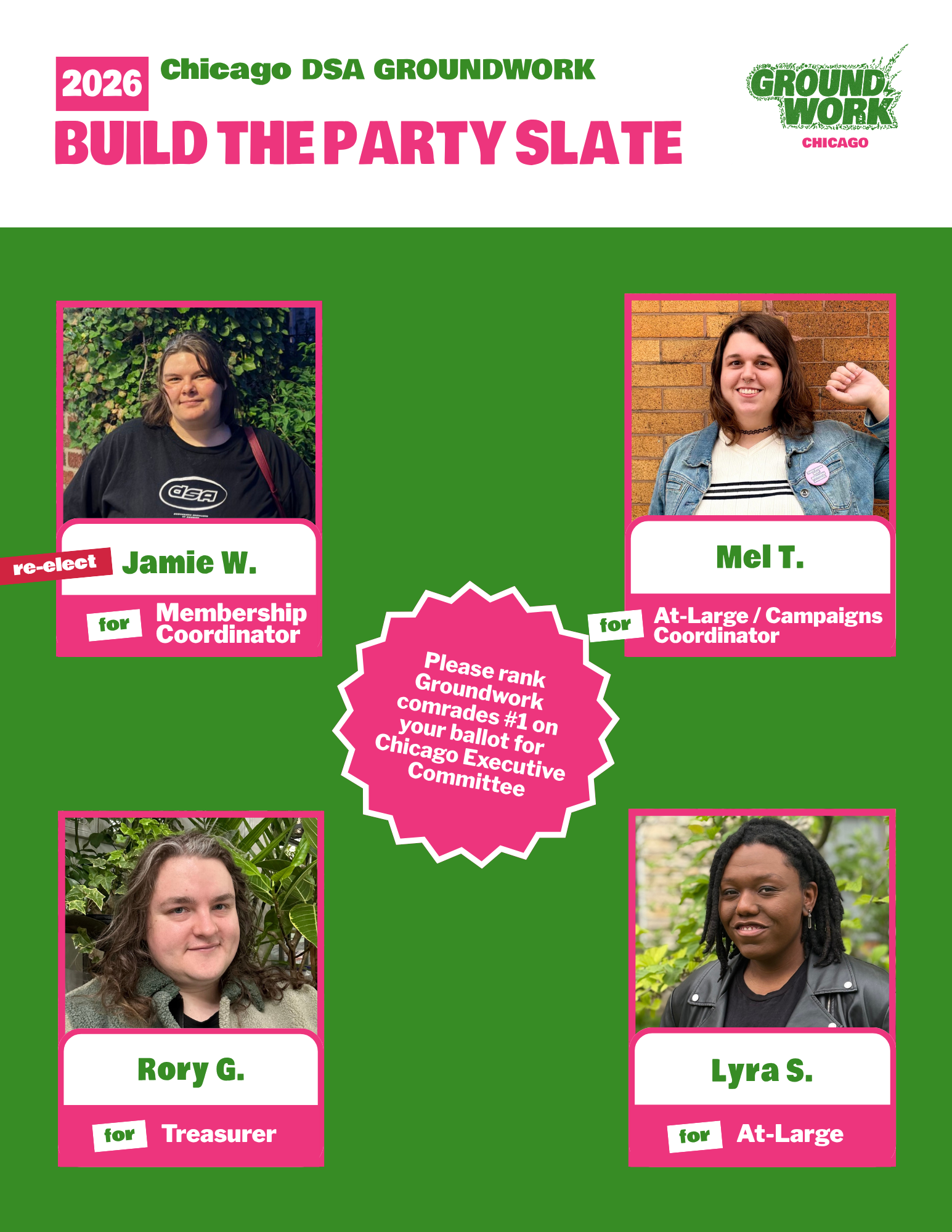
THe 2026 Chicago DSA GRoundwork Build The Party Slate
Foreword:
This past year has been a historic year for Chicago DSA. We’ve gained over 800 members, mobilized over 200 members in support of Byron Sicho-Lopez, and have turned our branches into the organizing heart of the chapter. While the previous year was transformative for Chicago DSA in many ways, we need to reach higher in our aims and ambitions as a chapter.
We believe that Chicago DSA can become a truly mass, multiracial, socialist, party. A party that has membership in the 10s of thousands and sends slates of socialist to city hall, the general assembly, and congress. A party that can mobilize thousands in the streets for protest, help unite the fragmented left/labor movements, and be the driving force in city hall, setting the working class in motion fighting for non-reformist reforms. A party that is deeply rooted in Chicago’s multiracial working class, with membership in every corner of Chicago, unsegregated by the red-lines of the ruling class.
Creating such a party takes time, effort, and dedication. Both 2027 and 2028 will be pivotal years for building up the party. Our platform today helps lay the groundwork for a mass party, and successful interventions in city hall, the state assembly, and even the presidential race itself.
Contesting for State Power:
Groundwork’s approach to fighting for, and wielding state power follows a similar model developed by NYC-DSA, which elected NYC Mayor Zohran Mamdani. We aim to contest state power by running socialists in winnable races that heighten the divide between workers and the ruling class. We also believe that DSA should be one of the driving forces in city hall, proposing and fighting for legislation that changes the material conditions of the working class and shifts the balance of power from the capitalist class to workers.
Candidate Recruitment & Development: Byron’s run has been transformative for the chapter, but had he not run, we would’ve ran zero candidates for the state assembly or congress. Part of building the party is taking a proactive approach towards elections and being able to reliably field a much deeper bench of candidates for these races. We will work towards developing a candidate pipeline by:
Working with MEC and EWG to regularly survey our membership and identify active members in strategic wards and districts who would be great candidates.
Working with Poli-ed and EWG to provide electoral skills trainings for staffing an electoral campaign and running for office.
Using our connections in unions, IPOs and other socialist organizations to identify socialist, class struggle candidates for elected office who are open to joining DSA, seeking our endorsement and joining our SIOC if they win.
Neighborhood Organizing: Local power in Chicago is vested at the ward level to a much greater extent than most other large US cities. While power in cities like New York is distributed through city-wide boards, alder-people operate as mini executives with million dollar budgets and effectively unilateral zoning prerogative. For Chicago DSA to truly be a party of the working class in Chicago that is capable of fighting the capitalist class, the party needs to be foregrounded at the ward level. As a chapter of transplants, this has been one of our weaknesses. We plan on fixing this through:
Working with the NSBL, South Side and WC branches to pass neighborhood/local stewards programs like the one developed by North Side Red Line, ensuring branch members are plugged into their local community.
Working with EWG and the branches to develop core groups of electoral cadre in every branch, who can help organize members to local organizing spaces, IPO meetings, ward nights, zoning meetings, and the like, and to help run electoral field programs directly within CDSA’s branches.
Coordinate with the Socialist in Office Committee to host DSA-sponsored constituent town halls with all of our endorsed alder-people.
Driving the Socialist City-Hall Agenda: Today, the left-wing in Chicago city-hall is disorganized and on its back foot, losing the few and modest gains it made during the early days of the Johnson administration. Currently, Chicago DSA has been a bystander while this has been going on, with rare interventions like the Corporate Headtax. We as a chapter need to prepare for two eventualities: 1) Brandon Johnson wins and we need to start organizing aggressively for material gains that can’t easily be overturned, or 2) Johnson loses and we need to be the most organized, primary, oppositional force against an austerity agenda in Chicago. To prepare for either potential reality, we will:
Working with the Electoral Research Group to develop the skills necessary for bill analysis and writing legislation.
Working with our SIOC to develop an agenda with concrete pieces of legislation that follow the Chicago Platform and Workers Deserve More, and introduce those bills in city council.
Develop and disseminate official position papers from Chicago DSA on relevant pieces of legislation, and mobilize our members in the form of micro campaigns to support such legislation, or oppose attempts at austerity.
Growth and development:
There have been very few periods of growth like the one we’ve seen over the past year. In 1 year Chicago DSA grew from about 1,950 members to over 2,700. While this growth has been great, it has largely been passive, relying on the Zohran bump. Chicago DSA still hasn’t hit its all-time high of membership, (3,000) while many DSA chapters have, including the national organization. Growing our ranks is vital to our party’s success. It means more money, more capacity to organize, and is the surest sign that we are making more socialists. It isn’t enough to just grow, however – developing leadership cadre is also a vital element in party building. Chicago DSA is currently missing its middle layer of leadership, and is struggling to elevate members to leadership roles in sustainable ways. We reject that we have to choose between a chapter that is growing or one that is developing cadre. On the EC, we plan to work towards growth and development through the following ways:
Development
An office in every branch: the Logan Square office has been crucial to the growth and development of cadre in the Blue Line Branch, and makes up a clear plurality of active chapter-wide leadership. We will work to fundraise and secure leases for an office in every branch, so each territorial branch gets increased opportunity to develop leadership cadre.
Membership engagement liaisons: Membership Engagement is the task of the whole chapter, not just the Membership Engagement Committee. To put this idea into practice, we will work to:
Develop a chapter-wide Membership Engagement Liaisons Program, with liaisons from every committee, working group, and branch, to help ensure MEC best practices are being implemented uniformly across the chapter, and that the Membership Engagement Committee always has enough volunteers to host DSA 101s, 102s, develop leadership, do listwork, and recruit new members.
Utilizing MEC liaisons to facilitate MEC events in their area of work, such as branch liaisons helping to host DSA 101s and 102s at the branch level, and helping branches out with list building and volunteer recruitment.
Office hours: With new offices opening up across Chicago DSA’s territory, members will have the opportunity to consistently collaborate with leadership and fellow DSA members. Office hours will help facilitate this through:
Providing a place and time for DSA members in branches to co-work together.
Providing a space for membership to work alongside EC and branch leadership.
Growth
3rd-largest chapter in the 3rd-largest city: Over the past year, Chicago DSA slipped from the 4th-largest chapter to the 5th, and we are currently on pace to become the 6th. Historically, our recruitment has been passive and uncoordinated. In preparation for the 2028 presidential race, our goal is for Chicago DSA to grow to a 4,000-member chapter.
Phonebanks: Working with MEC liaisons in the latter portion of the year to call through our list of 10,000 email subscribers, as well as non-members who recently came to CDSA events.
External campaigns: Recruiting volunteers, staff, and receptive community leaders through the rest of our 2026 electoral work and the 2027 aldermanic cycle.
Agit Prop: Working with branches and the city-wide agitprop group to start making recruitment asks and handing out Join DSA lit.
Neighborhood leads: Working with branches to expand the neighborhood stewards program piloted by NSRL, which will help us grow in less dense parts of our branch territory.
Multiracial Organizing:
One of the biggest factors preventing DSA from becoming a truly mass party of the working class is that it does not yet broadly reflect the demographic diversity found amongst the American working class. This is particularly a problem in a city like Chicago, which is heavily segregated. As socialists, we know that the ruling class has long tried to isolate the struggle of different minority groups, causing atomization among the working class. Worse, it pits segments of the working class against each other, like what was seen during the migrant crises. Having a party truly rooted in the multiracial working class, and organizing at the city level helps us de-segregate the oppression of the ruling class. A data center opening up in a predominantly Black neighborhood is now not only a concern of those residents, but also of those in Lakeview and in Pilsen. An ICE raid in Little Village is no longer a concern of solely those residents, but also the concern of those living in West Town, or Bronzeville. De-segregating our struggles makes us more likely to prevail against the ruling class, brings the atomized working class toward class alignment, and ultimately helps towards class formation. This is a years long struggle, but we plan on using our term on the EC to help by doing the following:
Prioritizing issue-based campaigns that are a strategic site of struggle for the multiracial working class such as ICE resistance, prison abolition, or the struggle against environmental racism, such as fighting data centers or a Green New Deal for public schools.
Prioritize running electoral campaigns and recruiting candidates from the south and west sides of Chicago.
Continue to work in coalition with longstanding movement organizations with multiracial, multilingual, multigenerational bases, such as ICIRR.
Support the growth, development, and funding of both the Multiracial Organizing Committee and the International Solidarity Working Group.
Work with MROC, branches, and community based organizations to do regular flyering, townhalls, and events in segregated, divested communities across Chicago.
Encouraging branches to start developing leaders in less member dense, areas of their territories who can start hosting satellite branch meetings
Fundraising:
Among DSA’s key strengths is that it truly is funded by our members. While our dues share from national has grown due to our increase in membership, it is no longer enough on its own to meet our needs. Chicago DSA should join other chapters in having local donations meet or exceed the amount we receive nationally by dues share.
Growing our fundraising apparatus is an essential aspect of party building. In order to do so, we commit to do the following:
Re-Establishing the Fundraising Committee: Within the first 50 days of the new officer term, meet as the Fundraising Committee at least twice. Work on the below priorities in tandem with the MEC, with regular written updates to chapter at large. The recent lack of any Fundraising Committee is the most significant source of our chapter’s unmet potential.
New Branch Offices: Establish recurring revenue to chapter specifically to support the new offices to make them fiscally sustainable not just for the year of our grant receipt. Host “officewarmings” and “rent parties” for comrades to donate upcycled furniture and pre-loved office supplies, to show there are more ways to contribute than just cold hard cash.
Local Donations Drive: Local donations is how most large chapters double their monthly income. We will work towards launching an ambitious recurring monthly donations drive with the goal of matching the amount of funds we get in national dues with recurring local donations.
Douglass Debbs Dinner: Make the dinner a focal point of chapter organizing, and be a joyous celebration of our comrades and our successes, in recognition of the important juncture we are at with local, statewide and national campaigns for 2026–’28. This reinforces our plank to put us back on track to being the 3rd largest chapter again.
A More Accessible CDSA:
Chicago DSA organizes over an incredibly vast and diverse territory. Our territory boundaries include Oak Park, Skokie, and Chicago neighborhoods as north as Rogers Park to Oaklawn. Currently, most of our chapter-wide events are held in the most member dense areas such as Logan Square, or in places that have easy transit access for most members in the city such as South Loop. While these locations work for many active DSA cadre, member surveys show that distance from CDSA events is a large barrier to chapter participation. Location of events isn’t the only barrier to accessibility. Our GCMs are the highest decision making body, and the only time rank and file members get a direct say in the chapter’s direction. These meetings are only once a quarter, 5 hours long, and have synchronous voting, meaning if you miss 1 meeting, you miss out on a quarter of votes for the year. In order to build a truly mass party, we must allow ways for members to participate regardless of geography or their work schedules. To ensure this, we will:
Work with the GCM subcommittee to explore cheaper GCM venues, with the goal of having more frequent, cheaper, and shorter GCMs.
Continue to work with the GCM subcommittee and MEC on circulating chapter wide events and socials throughout Chicago DSA’s territory.
Piloting a virtual pre-GCM chapter-wide meeting for first reads of proposals, poli-ed, officer, branch, and working group reports, as well as chapter-wide political discussion topics
Continue to cultivate well-moderated digital discussion spaces, particularly around specific topics, such as a Midwest Socialist article discussion channel.
Explore more ways to solicit member input such as membership polls, and continuing the member discussion bulletin.
Candidates