
Why We Run For Executive Office
By Eleanor Babaev, DSA National Political Committee member, Field Co-Chair of the New York City DSA Electoral Working Group
This past July, I attended a DSA 101 hosted by the Milwaukee DSA chapter where perhaps one of the most inevitable 101 questions was asked: how does DSA hold its electeds accountable? As someone who leads 101s myself in my home chapter of New York, this is one of the most common questions we get, and understandably so.
In the Mamdani era, most people find DSA through our electoral work. They also arrive already skeptical, because US policy hasn’t reflected public opinion in our lifetimes and the gap between what candidates promise and what they deliver is wider than ever. Finally, they arrive skeptical because DSA has had several public falling-outs with its own endorsees over deviation from our perceived party lines. When this question comes up, I typically explain that NYC-DSA focuses on a model of co-governance rather than a hyperfocus on accountability. To me, discussions of “accountability” in DSA are often the wrong framework, borne out of learned helplessness. This framework does not tackle the issue of Socialist in Office (SIO) discipline as an organizing task. Instead, in chapters with strong electoral programs, we have, through trial and error, come to tackle this issue by building party-like infrastructure.
In NYC-DSA, we have spent nearly a decade experimenting with co-governance. I will try my best to summarize our model. It begins with identifying and developing candidates who will treat DSA as their party. Next, candidates apply for endorsement by filling out a questionnaire where they commit to upholding basic socialist principles (as we define them, such as support for BDS) as well as attending weekly Socialists in Office Committee meetings and working with our socialist bloc once in office. Once endorsed, our candidate’s campaigns are almost entirely staffed by DSA members, from comms to field to policywriting. Once in office, NYC-DSA working groups act as policy shops for our SIOs and the weekly calls are used to streamline the work of our electeds, mediate tensions between them, and navigate the halls of power.
While the criticism from our opponents that our candidates “lack experience” is occasionally true, due to our preference for running working class champions and union organizers over career politicians, we have now built for our electeds a system that supports them in accomplishing their goals – whether they be legislative or agitational – that rivals those of our class enemies. The product of this system is that the success of our chapter and the success of our electeds are codependent. We are experimenting with what it might look like for one to need the other, for us to coordinate daily in every part of the job – not because we have ordered our electeds to, but because they actually have to. We are ultimately seeking for the tired carrot-and-stick metaphor to fall away entirely.
I use the word ‘experimenting’ repeatedly because there is no guidebook for what it is we are attempting to build here. We’ve spent the last eight years constantly tweaking our work – we haven’t always met our goals, and our relationships with our electeds have not always hit this mark. But more importantly, I am referring to our strategy as an actively developing process because we recently deviated from much of this orthodoxy by running and electing Zohran Mamdani. When we elect city councilors, state legislators, and congresspeople, we do it so they can be representatives of our politics. We are their base and they are there to create better conditions for our organizing. But we run mayors, governors, and presidents to grow our movement’s power to make that possible. Except for perhaps a naive few, no one who voted in October 2024 to endorse our then-little-known assemblyman’s race did so with the impression that we could always hold him accountable, that our working groups would have as much access to him as they do our legislators, or that he could govern without making significant concessions to public and private entities that have been building institutional power since before he was even born. This is not to say that the majority that voted for him would not have basic expectations of him – and in the time that he has been mayor, his occasional breaking with those expectations has resulted in sometimes-private, sometimes-public reproach. But it would be safe to say that a majority of those who voted for him did so for some combination of the following three reasons:
1. His campaign would provide a platform to agitate for our politics on a larger scale, particularly against the genocide in Gaza (Zohran the Agitator).
2. Having a cadre socialist in the highest seat of power would necessarily mean better outcomes for working people in this city (Zohran the Best Option).
3. A campaign of this scale would catapult DSA into the mainstream and usher in massive membership growth (Zohran the Party Builder).
All of these were perfectly good reasons at the time to support his candidacy. However, the first two approaches contain flaws that, when taken in a vacuum, would not have set DSA up for long-term success. The successes of the socialist project in the US are a result of having learned not to engage in agitational campaigns without a focus on party building and a real plan for victory and governance. One only has to look at perennial losers like Jill Stein and Claudia De la Cruz to see the brutal result of running a protest campaign for its own sake. Even Mike Gravel, who recognized that a campaign whose goal is purely to “change the conversation” needs to be capable of getting onto the debate stage, hardly changed the conversation in a lasting sense. Such agitation-only campaigns offer the socialist movement nothing but stagnation because voters are rational actors who are activated by candidates offering a real shot at improving their lives. It is not as though there are other external variables that contribute to PSL and the Greens’ marginality. They are not short for mega-donors that could spend enough to make their candidates seriously competitive. They are failures on their own merits. For these parties, the strategy is not even to attempt to win. It is instead to chip away at the edges of disaffected America every four years like self-righteous cicadas, doing little to nothing in the interim to develop those voters’ abilities to replicate themselves, to organize their workplaces, or to talk to their neighbors.
What Bernie and DSA offered in 2020 was a path out of this death spiral – he ran to win, and DSA was there to catch the enthusiasm. By speaking to issues Americans care about with the intention of bringing as many people into his movement as possible rather than intentionally alienating anyone who might disagree; by investing in a massive field operation; and by having a decades-long record that made him a trustworthy figure in the eyes of Americans of all political persuasions, he became not only viable on day one, but someone millions put their faith in. His campaign singlehandedly opened up the possibility for Americans to identify as socialists en masse, and the organizing DSA has done since has made Democratic Socialism more popular among Democratic voters than capitalism.
What are the results of this? In New York, it has resulted in our chapter electing a bloc of socialists to the state legislature – socialists who have delivered on transformative tenant protections, historic steps towards public ownership of utilities, and a slew of anticarceral legislation. We have not only improved the lives of New Yorkers, but indeed shifted their consciousness – housing is now seen more as the human right that it is, and an end to fully private ownership of vital industries now seems possible. But if improving people’s lives was enough to get DSA’s endorsement alone, we’d endorse every progressive we came across. We can’t use the lessons we’ve learned from years of marginalization to overcorrect and run purely on being the best option. Instead, we in NYC-DSA work with our electeds to practice a class-struggle deliverism, one where the goal is to raise consciousness about the power of the working class and the need for a socialist party. While agitation and deliverism sit on opposite ends of the spectrum in classic intra-left electoral debates, socialism succeeding in New York City is actually a result of the complementary nature of the two, as well as the constant dynamic assessment of where and when an emphasis on either end builds our party.
Endorsing Zohran for executive office in late 2024 came with cross-tendency anxiety. What if his campaign never took off and we were relegated to the category of jokers and cranks who got ahead of their skis? What if he won and couldn’t deliver on any of his promises, turning New Yorkers against socialism for decades? What if he won and did start delivering, but only by abandoning his political home? It may be still too soon to tell whether these anxieties can be assuaged, but his ability to capture the positive spirit of his campaign has allowed him to remain popular, and he continues to meet with and act on feedback from DSA leadership regularly. Those who are often critical of the efficacy of winning an executive seat, such as our comrades in Marxist Unity Group, are partially correct when they say that electing someone to executive office – especially while the legislature is hostile – is not necessarily a skeleton key to defeating the power of capital, which can by and large march on unscathed. But these critics’ rigidity ignores the dialectical nature of how power is built and where socialists should believe it resides. It is not the mere act of passing radical reforms such as universal childcare that “advances socialism.”
In New York City DSA, Democratic Socialism has not just been a promise that workers can live a life unburdened by a skyrocketing cost of living. It is a verb, a practice we have used to engage millions in campaigns. In the months leading up to the 2025 mayoral elections, the Zohran campaign was everywhere. For adults under 40, there was a sense that it was the thing to do. Even if you weren’t one of the 100,000 volunteers, you probably knew someone who was. Distance runners ran Strava 10Ks for Zohran, concertgoers placed bets on whether he would make an appearance at their shows, and bartenders offered drinks on the house to patrons overheard discussing the phenomenon. Whether the three main promises from his campaign were or will be fulfilled by Zohran himself ultimately matters less than DSA’s historic growth, driven by the cultural ascendancy Zohran has offered.
Our chapter has since absorbed 8,000 new members – members who now attend socialist book clubs, members who are now plugged into rank-and-file union reform networks, members who are now trained in organizing their workplaces and apartment buildings, members who now have the resources to build socialist bases in their neighborhoods and run ICE patrols, and members who participated in adding seven new electeds to our Socialists in Office bloc in the state legislature this June. Unfortunately for those who dislike the contradictions that come with running for executive office, running for legislative office could not and has not made this possible on its own.
Working people feel that something is wrong with our political system. We know we don’t have the time to chip away at getting 50+1 votes on legislative bodies. The dysfunction of legislatures – particularly the biggest of all, Congress – has suffocated voters, driving them away from believing these bodies are worth their attention and interest at all. One might even conclude that legislatures are now boring to voters, at least in comparison to deciding who the next face of their city, state, or country will be. It is not that legislators cannot be impressive tribunes of the working class. One only has to observe DSA join trends after AOC won her primary in 2018 or the following Chi Ossé has built on Instagram explaining what is wrong with our city to understand legislators can build consciousness. But their utility as such has diminishing returns when they are structurally prevented as individuals from transforming people’s lives. Executives, on the other hand, are spokespeople – they embody the character and the voice of the majority and in doing so retain far more symbolic value to the voter. Despite the excitement for our two Congressional campaigns in this cycle, voter and volunteer turnout in NY-7 and NY-13 was nowhere near what it was for Zohran last year. Voters come out in droves for the revolutionary symbol offered by the executive.
Mayors, governors, and presidents also have limited structural avenues for directly improving workers’ lives – this often unglamorous work is done on the shop floor, at the bargaining table, and in legislative majorities. But what executives can do is use their bully pulpit to coalesce and pressure lawmakers into passing legislation that makes it easier for workers to organize. More importantly, they can also use their platforms as figureheads for our proto-party. Notable iterations of executive partybuilding in recent years include Bernie’s famous “Organizer in Chief” promise to host massive rallies all over the country and engage people in pressuring their senators to pass Medicare for All, Zohran shouting out DSA during his victory speech on election night and frequently attending DSA hosted events throughout the campaign, and Wisconsin gubernatorial candidate Francesca Hong turning her campaign office into a mutual aid hub and interviewing national DSA co-chair Ashik Siddique. In Wisconsin in particular, DSA membership has nearly doubled statewide as a result of Hong’s unapologetic and repeated socialist identitarianism, as well as DSA’s involvement in the campaign. It is likely that as governor, Hong may be even less in-touch with her DSA base than Zohran has been as mayor, having to work in more hostile terrain with an even broader coalition. But Hong is also poised to enter office under a democratic trifecta, with a small coalition of socialists in the assembly. Moreover, the Wisconsin Supreme Court is set to potentially repeal Act 10 – a relic of the Scott Walker years that stripped public sector unions of their collective bargaining rights. The post-Act 10 environment would usher in exponentially more favorable conditions for working class organization, a moment the socialist movement is already actively organizing to meet.
A DSA campaign for President of the United States could usher in a similar paradigm shift, at an obviously greater scale. While a truly cadre DSA presidential candidate (like Zohran) capable of proving viability and capturing our existing nationwide momentum is unlikely to emerge, Alexandria Ocasio-Cortez has remained one of the most famous Democratic Socialists and one of the most popular politicians in the country since she burst onto the scene in 2018. With Republican favorability dipping to a historic low, it is likely that, were she to win, she too could preside over a relatively friendly Congress. However, the lack of favorable conditions for an executive to operate in should not alone dissuade socialist seizures of executive power. While she would likely deviate to a significant degree from our national Workers Deserve More Program (WDM) – if not in policy, then in messaging – her socialist self-identification, generationally impressive class struggle messaging, and ability to mobilize working people would provide ample material for party building worth our investment.
If we choose to assess the races we run as tools rather than ends in and of themselves, we will be better poised to organize through them. Treating every race like a sprint after which we find ourselves disappointed is a choice, a rake we continue to step on as the left. In fairness, however, such cynicism is also how a majority of Americans experience elections. There is a real need to communicate to the American people that we aren’t fools who hitch our wagons to every shiny new candidate promising us something free – or worse yet, con-artists seeking to deceive them by promising them a nice society and instead just gaining power for party members.
To resolve this tension, our comrades in the Reform & Revolution caucus have suggested a ‘critical endorsement’ of AOC for president. While I’m sure the merits of this are fairly reasonable, I have yet to see an organizing plan explaining how this critical distance would move the needle in DSA’s favor in practice. I can imagine that in certain regions, it might make sense for DSA canvassers to include in their conversations that our candidate won’t be a magic bullet. But this critical endorsement tactic can’t be applied systematically in the field, especially in denser cities where canvassing conversations tend to be much shorter. If we look to comms to execute this strategy, we ought to be realistic about our reach. Would our criticisms exist to assuage left-wing social media influencers and streamers, or would they exist to truly reach and activate working people? In order to actually achieve the latter, DSA for AOC needs to be laser-focused on movement building, not the myopic circular firing squad of the left. The conditions that an AOC candidacy (or presidency) would create would lay the foundation for the self-emancipation of the newly activated masses. We would have to be comfortable with AOC running as herself, not just as a tribune of Workers Deserve More, because her campaign will create the conditions that will make true programmatic socialism at the national level not just preferred but inevitable – but only if we are there to actually organize for it. Critical distance and abstention in name or deed only hurts our own ability to project that we are in fact building a movement, while bringing her no closer to our goals.
DSA for AOC can only be successful if we endorse early and with the goal of vigorously identifying ourselves with her campaign. It can only be successful if we make the case that at this stage, our organizing is as much an end in and of itself as it is a means of achieving material gains, and it can only be successful if our organization becomes rapidly more dynamic in its engagement with and understanding of the goals of every new campaign. Despite the dynamics of celebrity that come with being a candidate for mayor or president, socialist campaigns for executive office are less about the candidate and more about what we can do when we reach greater magnitudes of people. Seven years ago, the phrase “Not Me, Us” permanently altered my conception of what electoral politics are for and changed the trajectory of thousands of organizers’ lives. Today, those thousands should say: “Not AOC, The Party.”
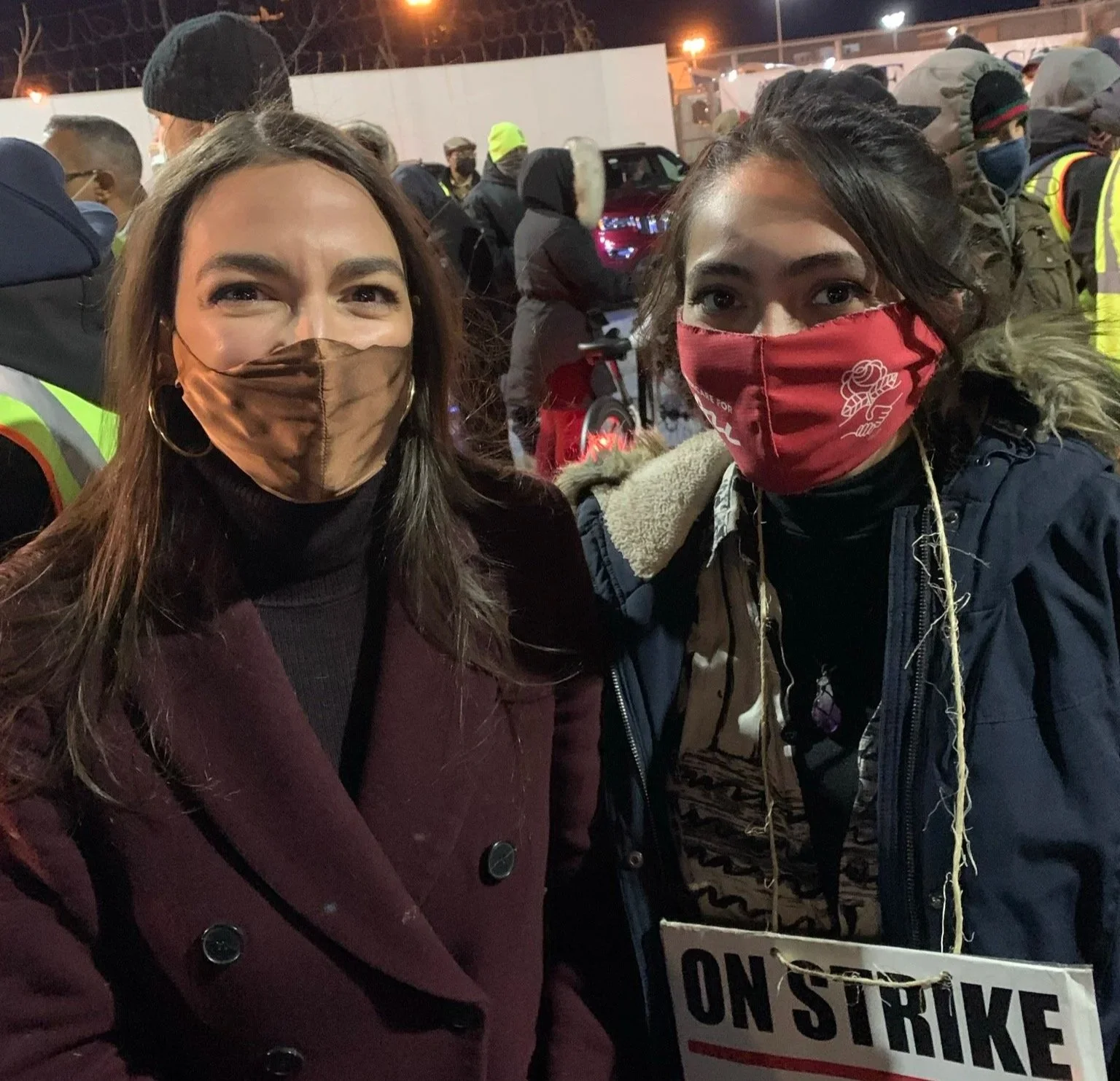
Eleanor Babaev and Alexandria Ocasio Cortez at the Hunt’s Point Strike Picket Line, January 2021
