
Creating the Conditions For Victory: Lessons for DSA From Darializa Avila Chevalier's Campaign
By James I., Data Director for Darializa for Congress, NYC-DSA Steering Representative from the Bronx/Upper Manhattan Branch
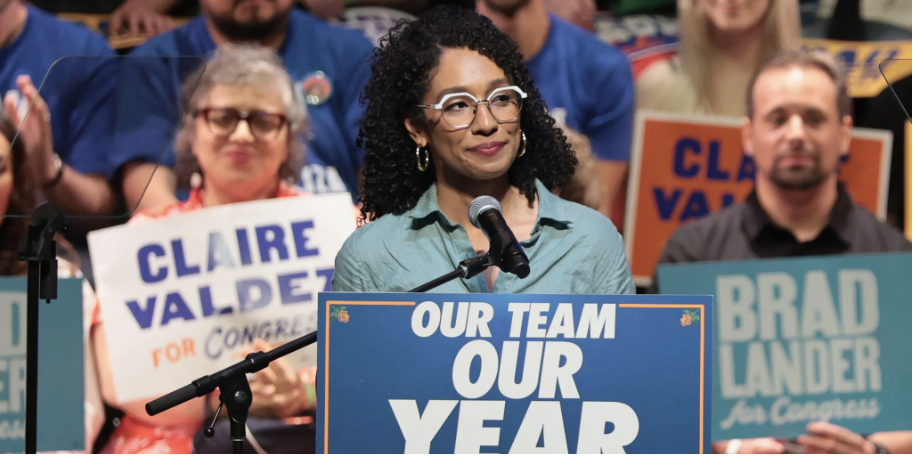
Congressional candidate Darializa Avila Chevalier speaks during a rally at King’s Theater on June 18, 2026, in New York City. Photo: Michael M. Santiago/Getty Images
I. Introduction
In the fall of 2025, NYC DSA was riding high after its mayoral candidate, Zohran Mamdani, won the mayoralty in a stunning upset. The chapter's central strategic question quickly became where to contest elections in 2026 to capitalize on that momentum and expand DSA's electoral footprint.
One of the districts under serious consideration was New York's 13th Congressional District. In the Democratic mayoral primary, Mamdani had carried the district by 19 points in the final round of ranked-choice voting despite incumbent Representative Adriano Espaillat endorsing Zohran’s adversary Andrew Cuomo. Espaillat also entered the race with his own vulnerabilities. His longstanding tensions with Harlem's political establishment had limited his appeal among some Black voters, while his support from AIPAC increasingly drew criticism from progressive and younger constituents. Together with Mamdani's strong performance in the district, these dynamics suggested that NY-13 could be fertile ground for a democratic socialist campaign.
Still, challenging Espaillat would be no small undertaking. He had spent many years building up a political machine in the uptown Dominican community, earning a reputation as one of uptown’s main political power brokers. Espaillat fiercely defended his status and anyone mounting a serious challenge would face an entrenched incumbent that would receive millions in backing from AIPAC. Put simply, if you came for the king, you could not afford to miss.
It was into this political environment that democratic socialist Darializa Avila Chevalier announced her campaign on November 20, 2025. Darializa spent many years in the Palestinian rights movement and understood intimately the frustration that uptown residents were feeling about the incumbent’s steadfast support for Israel after two years of watching Israel’s genocidal campaign in Gaza. Another issue weighed heavily on the incumbent's record: his response to the attempted deportation of Mahmoud Khalil. Khalil was targeted by the Trump administration for his role in the Columbia University Palestine protests. Darializa spent months organizing against his deportation. Khalil himself later said that Espaillat did not reach out to him or his team until nearly a year later, after Darializa had announced her campaign. For Darializa's campaign, the ordeal was emblematic of Espaillat’s approach to Palestine, immigration enforcement, and a lack of care for the constituents of NY-13 like Mahmoud Khalil. The salience of these issues created fertile ground for a challenge, but it remained to be seen whether they could be harnessed appropriately. These conditions made the race plausible, but not necessarily viable.
Despite this, campaigns do not win just because favorable conditions exist. They win because organizations build the capacity to take advantage of those conditions. When DSA conducts endorsements, they consider two main factors: viability and ideological alignment. However, DSA has only just begun to understand a third: malleability. DSA should view endorsements as not just opportunities to co-sign a winner or boost an ideological ally but as opportunities to shape campaigns while they are still in their formative stages. Darializa's campaign offers a case study in what can happen when DSA commits early to not just endorsing a candidate, but to building the campaign itself.
II. Initial Skepticism
My perspective comes from serving on NYC DSA's Electoral Working Group (EWG) as the Bronx/Upper Manhattan (B/UM) rep, in which capacity I interviewed Darializa during the endorsement process. Then, in late November I joined her campaign and served as her data director, giving me a front-row view of how early organizational intervention transformed the campaign.
Taking on a machine incumbent like Espaillat would have been a difficult challenge even for an established elected official with an existing political base, let alone a first-time candidate. At the time of the endorsement process in December, the campaign had only recently launched. Staffing was minimal, volunteer infrastructure was still being built, fundraising had only just begun in earnest, and many of the systems necessary to run a competitive race had not been developed yet. Those conditions fueled skepticism both inside and outside DSA that this challenge was worth taking a risk on. Many members graded the campaign very poorly on that first factor of viability. However, Darializa received much higher scores on that second factor of ideological alignment,
During the endorsement process, Darializa was the type of candidate where the more members saw of her, the more they liked her. Members began to feel she was a committed democratic socialist, and heavily respected the work she has done to fight Israeli apartheid. Her leading with an anti-war message of “Babies Not Bombs” on her campaign was particularly resonant.
Darializa's campaign reflected the politics of a DSA campaign, but not one people saw as viable yet. Many members were caught between a rock and a hard place of believing in the vision of the campaign, but not seeing a path to victory. Just as importantly, the B/UM branch had never won an electoral campaign of its own, despite multiple prior attempts. Many members were concerned history would repeat itself this cycle. Even members who believed in Darializa questioned whether the organization itself had the capacity to take on a congressional race uptown, let alone against someone who was the boss of a political machine. Ultimately the question before DSA was whether to value the lack of viability based on the current early conditions or value the amount of potential that the campaign had; I joined Darializa’s campaign because I chose the latter. That distinction would prove decisive. An early endorsement was not simply a judgment about the campaign's present condition, it was a commitment to helping bring about the conditions necessary for victory.
III. The DSA Difference
One of the biggest misconceptions about campaigns is the strength of a candidate exists in a vacuum. In reality, organizations mold candidates. They refine messages, build confidence, expand political horizons, and develop the campaign infrastructure that allows candidates’ strengths to flourish. A good campaign is one that develops the candidates and brings out their best qualities.
That is the "DSA difference." For NYC-DSA, an endorsement is not simply permission to place a logo on campaign literature. A DSA endorsement is a commitment to developing the campaign itself. Members step into key leadership roles, organize field operations, develop strategy, and leverage relationships with allied organizations to support the campaign. The goal is not merely to support a candidate, but to create the conditions necessary for victory.
DSA is such an asset to a campaign because our talent pool is so diverse. If the campaign needs a specific type of job done, we can literally find someone in our member network who would be willing and able to get the job done fast. Therefore, DSA provides the volunteer and staff infrastructure that allows campaigns to scale up and be competitive. Our volunteer base in BUM was able to create an operation of several dozen field leads and over a 100+ people consistently canvassing each week, even before Zohran’s fateful endorsement.
When the campaign needed someone to build a data operation, DSA already had members with that expertise. When it needed field leadership, organizers became field leads. Rather than wasting time and money hiring every specialization from scratch, the campaign could draw from our existing talent pool.
IV. Changing the Win Condition
A common approach to challenging entrenched incumbents is to treat the first campaign as an investment in the future: build name recognition, establish credibility, and prepare for a stronger challenge years later. From the moment I joined that campaign, I rejected that framework. The goal was not to run a campaign that would make the next campaign easier but to create a campaign that could win this cycle.
Even after receiving the DSA endorsement, the skepticism regarding Darializa’s viability still lingered; for a while DSA and Justice Dems were her most prominent backers. Many organizations were too scared to oppose Espaillat and treated his victory as a foregone conclusion. In March, Darializa’s team hired a new campaign manager who brought the campaign a new level of strategic clarity, operational discipline, and leadership that was aligned with the DSA project. More importantly, her collaborative approach allowed DSA members to fully utilize their skills rather than simply function as volunteers filling gaps.
My role as data director demonstrated another way early infrastructure changes a campaign. I didn’t just use data for tracking progress. Instead, I made our data a feedback loop that allowed the campaign to continuously improve. Field results informed our messaging strategy, helped identify if volunteers needed more training in the field, and allowed us to adjust our organizing approach in real time. Data became a key tool for the campaign to learn and grow.
Like many people on the campaign, I wore multiple hats as needed. On DSA campaigns people are not just limited to a single role; they are encouraged to step up wherever the campaign needs capacity. I would draft social media responses, clip videos, and work on anything else that we needed more hands for. Beyond winning the race, I saw the campaign as an opportunity to develop new leaders within B/UM. I badly wanted to both win this race and use it as an opportunity to train a new cohort of DSA organizers on the nuts and bolts of campaigning. I personally trained a team of field data volunteers to cut turf and tag voters on the backend during petitioning; this team was a critical component of ensuring our field team could meet the demands of a congressional campaign. People who had never managed volunteers, cut turf, analyzed data, or shaped messaging were able to gain those skills and become organizers who can lead future campaigns.
We often debate how much discipline to apply to electeds to ensure they do not deviate from the project, but carrots are just as important as sticks. Celebrating growth and praising progress are a key component of ensuring candidates nestle deep with our SiO project. We should leverage our relationships with candidates to ensure that they are not just aligned with the project, but that they enjoy being part of it.
I was aware that this campaign was a major undertaking from its inception and would take time to check in with people on the campaign and see how I could support them. The weight is also felt most heavily on the candidate’s shoulders. Consequently, I would make time to check in with Darializa, give her words of encouragement, praise her growth, share positive moments from the campaign, and build my relationship with her as a member of DSA leadership. Beyond ensuring her morale was high, I wanted her to feel the gravity of her role in building the DSA project. The examples I shared came from positive anecdotes in the field from voters excited to support her, conversations with DSA members who were becoming increasingly optimistic about the campaign, and data showing how the campaign was helping grow the organization. The B/UM branch was consistently the fastest-growing branch in NYC DSA throughout this spring, and Darializa was always energized when I shared that progress with her; she loved the campaign was building new local organizers. I would often tell Darializa, "the candidate I interviewed is not the candidate you are now." I meant it; her growth as a candidate throughout the campaign was very rapid. Over the course of the campaign, she became more confident, more capable of communicating her vision of a “politics of life” where we spend money taking care of our community instead of bombing countries abroad, and more introspective about how both she and the campaign needed to grow. The infrastructure DSA helped build gave her the security to feel confident and express her best qualities. When candidates see volunteers showing up, voters responding positively, and an organization believing in the possibility of victory, they are able to campaign differently, to be less timid and to truly believe in the potential of the collective project. Candidates set the tone of the campaign, but the campaign shapes the candidate right back.
This is one of the reasons early intervention matters. While it is important to run cadre DSA candidates, it is also important when we engage with non-cadre candidates and their campaigns to lead them closer to our ideal. This early intervention by DSA created a campaign that aligned staff, pursued a robust field operation that developed members skills, trained volunteers that touched every corner of a new district for us, brought to being layers of data infrastructure, and produced a candidate who had grown through the process. DSA had not just provided Darializa’s campaign with more resources, they had used those resources to create organizational capacity necessary to win the campaign.
V. Lessons for Future DSA Electoral Work
The main takeaway from Darializa's campaign is that campaign viability is not fixed, but instead something DSA can actively shape. Campaigns are dynamic structures that evolve over time. Staff are hired, volunteers become leaders, systems are built, and candidates grow into their role. Early intervention matters because it shapes those developments while a campaign and the candidate are in that early, malleable stage.
It is not enough to simply endorse a compelling or ideologically aligned candidate. Early intervention should help develop that candidate over the course of the campaign and make them the best version of themselves. Darializa entered the race with deep movement experience and a compelling message, but DSA's investment sharpened those strengths by providing the infrastructure and guidance that allowed them to flourish electorally. That’s what laying the groundwork means on the most practical level- doing the thankless, early, necessary, constant work of development to ensure everyone is able to reap the benefits together in the end.
Furthermore, we also cannot judge campaigns solely by whether they win office. A successful campaign develops organizers, trains future leaders, and leaves behind greater organizational capacity than existed before the race began. Many of our B/UM campaigns that did not win had, to belabor the reference, laid the groundwork for this moment, creating organizers and infrastructure that would pay off in Darializa. This campaign in turn developed new leaders, particularly BIPOC leaders uptown and in the Bronx, that will use these skills to drive future wins in DSA.
The question for future campaigns should no longer simply be: "Can this candidate win?" The better question is: "What role does DSA play in shaping the viability of a race?"
VI. Conclusion
Darializa's campaign demonstrated that campaigns are dynamic systems and that viability is not a fixed variable. They are organizations that evolve. Candidates develop. Volunteers become leaders. Campaigns learn. The earlier an organization like DSA intervenes, the more influence it has over that process.
That does not mean early intervention always produces victory. DSA still needs candidates who are willing to work collectively with the organization and embrace the project of building a member-led campaign; people can only be part of the project if they want to be. Interventions worked with Darializa’s campaign because there was much of a sincere desire to be part of the SiO project. Darializa consistently embraced feedback from DSA and pushed herself to be a better candidate. But if DSA waits until campaigns already possess the staff, infrastructure, confidence, and organizational maturity needed to win, then it has already surrendered much of its ability to shape those outcomes. Those key advisory roles will get filled by consultants, progressives that are not DSA aligned, etc. The greatest value of an endorsement is not just supporting a candidate, but influencing them and creating the conditions for victory.
Darializa's campaign reinforced a lesson I hope DSA carries into future electoral work: the role of a movement organization is not simply to identify winning campaigns, it is to help build them. Nowhere is understanding this lesson going to be more critical than in 2028, when DSA and its chapters are expected to be endorsing a Presidential candidate and dozens more House candidates. If we are to ride this wave of success for socialism, we better know how to mold it- it’s the only way to prevent devolving into tailism or irrelevancy.
