
Every Door, Every Neighborhood: Building a Working-Class Party in Greater Boston
By Brett K., Danny H., Josh S., and Trey D., members of Boston DSA running for the chapter's Coordinating Committee
April 23, 2026
Somewhere in Greater Boston, on a street Boston DSA has never canvassed, a worker is paying too much rent for an apartment their landlord won't fix, is waiting on a bus that comes less often than it used to, and has no reason to believe that a socialist organization exists that considers them its constituency. Most of the working class in Greater Boston fits that description: majority people of color, multilingual, and rent-burdened, in Boston and the inner-ring cities beyond it, and Boston DSA has not yet knocked their doors. That is what we are organizing to change: we are building a working-class party with real roots across this region, a fighting program, and a left-labor coalition capable of winning the political and economic power this majority has never had an organization powerful enough to secure.
Massachusetts is a state where Democrats hold a supermajority in both chambers of the legislature and have used that dominance not to build working-class power but to insulate incumbents from being held accountable to the workers who elect them. The party's real function is to give working-class constituencies a holding pen while delivering for the developers, insurers, and the financial sector that funds its incumbents. The state is carved into scores of small cities and towns, each powerless to raise their own revenues or enact tenant protections without permission from the State House, which is rarely granted. Under these conditions, it is working people who pay the price: in rising rents, crumbling transit, and a climate agenda written by the utility companies that have steered energy policy in this state for decades. We are Marxists and Democratic Socialists, which means we understand these conditions not as a string of independent policy failures but as the predictable outcomes of a political economy organized around profit rather than human needs. Building the organized working-class counterweight to that political and economic order is the reason Boston DSA exists.
Across five campaigns in 2025, Boston DSA gained momentum: chapter members knocked over 100,000 doors and developed 28 field leads. We have elected three of our own members to city councils in Cambridge and Somerville, built a Socialists in Office Committee that members of the Groundwork slate helped draft and now help lead, and are preparing to fight for the 2026 Massachusetts statewide rent control ballot question, which would establish statewide rent control for the first time since the real estate industry's 1994 ballot campaign stripped rent control from Massachusetts.
However, none of this organizing is happening in a stable political environment. ICE has become an instrument of mass terror in Massachusetts, dragging workers from car washes in Allston, abducting pro-Palestine activists in Somerville, and terrorizing immigrant families in East Boston and Chelsea. Where we have not built presence in these communities, we cannot simply show up and call it solidarity.
We have not yet built the depth our moment demands. Greater Boston's working class is multiracial, multilingual, and majority people of color in the city proper, concentrated in specific neighborhoods through decades of redlining and disinvestment. A chapter not genuinely present in those communities cannot represent them, however correct its program. We have built real strength in Cambridge and Somerville, but that strength is a foundation we intend to build from, not a boundary we intend to remain within. Electoral campaigns, labor relationships, and neighborhood organizing are not separate tracks but mutually reinforcing fronts of the same class struggle. The chapter's job is to coordinate across all three simultaneously rather than letting each working group pursue its own priorities in isolation. The organizational form that makes that coordination possible is the Neighborhood Group—locally embedded organizations in Allston-Brighton, Roxbury, East Boston, and beyond that canvass their own turf, develop their own leaders, and build the local relationships that allow electoral, labor, and community organizing to reinforce each other on the same terrain rather than running in parallel from across the city.
The coordination we are describing across electoral, labor, and neighborhood organizing is not a strategic framework to be adopted at convention and forgotten—it is the work we are already doing. We see the potential for BDSA’s electoral power and labor power to be mutually reinforcing, and are actively organizing to make this a reality in unions that have previously been hostile to our endorsed candidates. SEIU Local 509, a major union in Massachusetts, endorsed against Evan MacKay when they previously ran. This time around, members of our slate have been organizing within SEIU Local 509 to secure an endorsement of Evan. That is the difference between a transactional endorsement and a political relationship: treating the union not as a gatekeeper to be lobbied but as a political formation to be organized from within. Rather than assembling a left-labor coalition fresh every election cycle, our slate seeks to build it on sustained relationships.
Our proposed local Workers Deserve More platform gives every member a common language to organize around. We are fighting for universal rent control and social housing, a fast and free T, MassHealth for All, and unions for every worker regardless of industry, the things that working people in this region have been denied not by accident but by the deliberate choices of the class that runs this state. We demand divestment from Israel and war profiteers, an end to ICE collaboration and all state complicity in deportation, and a millionaires tax whose proceeds don't get clawed back the moment they're collected. On climate, we follow the model our comrades in New York City DSA won with the Build Public Renewables Act: putting energy and transit into public hands, creating union jobs, and bringing fossil fuel workers into the green economy rather than abandoning them.
The 2026 rent control campaign will deploy members across every neighborhood in the region, knocking doors in communities we have only sporadically reached and seeding Neighborhood Groups in parts of this region where DSA has been absent. Our labor circles, gatherings that connect rank-and-file union members across the chapter, are developing the organic connections between workplace organizing and socialist politics. Evan MacKay's campaign for the 25th Middlesex District State House seat is already underway, with the primary on September 1, and we will be in the field with a chapter far greater in scale and more deeply rooted than the one that came within 41 votes of winning in 2024. When Evan wins, our Socialists in Office Committee will be ready to make good on the promise that a socialist in office is an extension of the movement, not a substitute for it, and Evan will not be alone for long.
We are not waiting for 2027: we are identifying winnable districts across Boston, Somerville, Cambridge, and Lowell, building the coalitions that make those races possible, and developing cadre candidates from our own ranks. In 2028, we want multiple State House races to build a socialist bloc in the State House that can fight for universal healthcare, free transit, and a green economy on working people's terms.
This is the vision driving the four of us to run for Boston DSA's Coordinating Committee this year, and this is how we intend to do it: we will run consistent trainings on communications, data analysis and management, field organizing, and structured organizing conversations. Through this, we will move members up the engagement ladder deliberately and build an organization that more members can actually lead. We will show up at high-profile mass actions, treating No Kings, Pride for the People, and the mobilizations that bring thousands into the streets as organizing opportunities, with recruitment infrastructure behind them. We will build the communications capacity to reach beyond our existing membership: consistent materials that carry our campaigns to workers and tenants who have never heard of DSA, and a digital presence that makes DSA legible and accessible to the working class we are trying to reach. The chapter's administrative and financial infrastructure exists to serve the organizing and the members doing it, not the other way around. We will make it do just that: faster reimbursements, payment cards for routine expenses, transparent reporting, and coordination support that treats neighborhood groups as the chapter's front lines.
We are running as members of Groundwork because we share its answer to the central question facing the socialist left: how do you build a mass working-class party in the United States, now, with the organization we have? Groundwork's answer is that electoral work and labor organizing are not separate projects but the same project at different registers: strike power, state power, and street power, with each reinforcing the others. Winning elections shifts the terrain on which workers fight, a labor movement rooted in socialist politics makes those wins durable, and mass mobilization builds the power that makes both possible. We know that DSA grows when it makes credible political interventions that present socialism as a winning proposition, not when it waits for external crises to recruit for it. Boston Groundwork takes seriously the need to understand what this political moment makes possible, and to organize deliberately to make our own history, rather than wait forever for more favorable circumstances that will not come on their own.
Conclusion
The working class of Greater Boston is the majority and has never had a political project to call home. Building one is the historical task of this organization. In five years this chapter can be 10,000 members strong with a socialist bloc in the State House, thriving Neighborhood Groups from Chelsea to Lowell, and a left-labor coalition that the Democratic establishment in this state has no answer for. That future is not guaranteed. We intend to organize it.
Solidarity
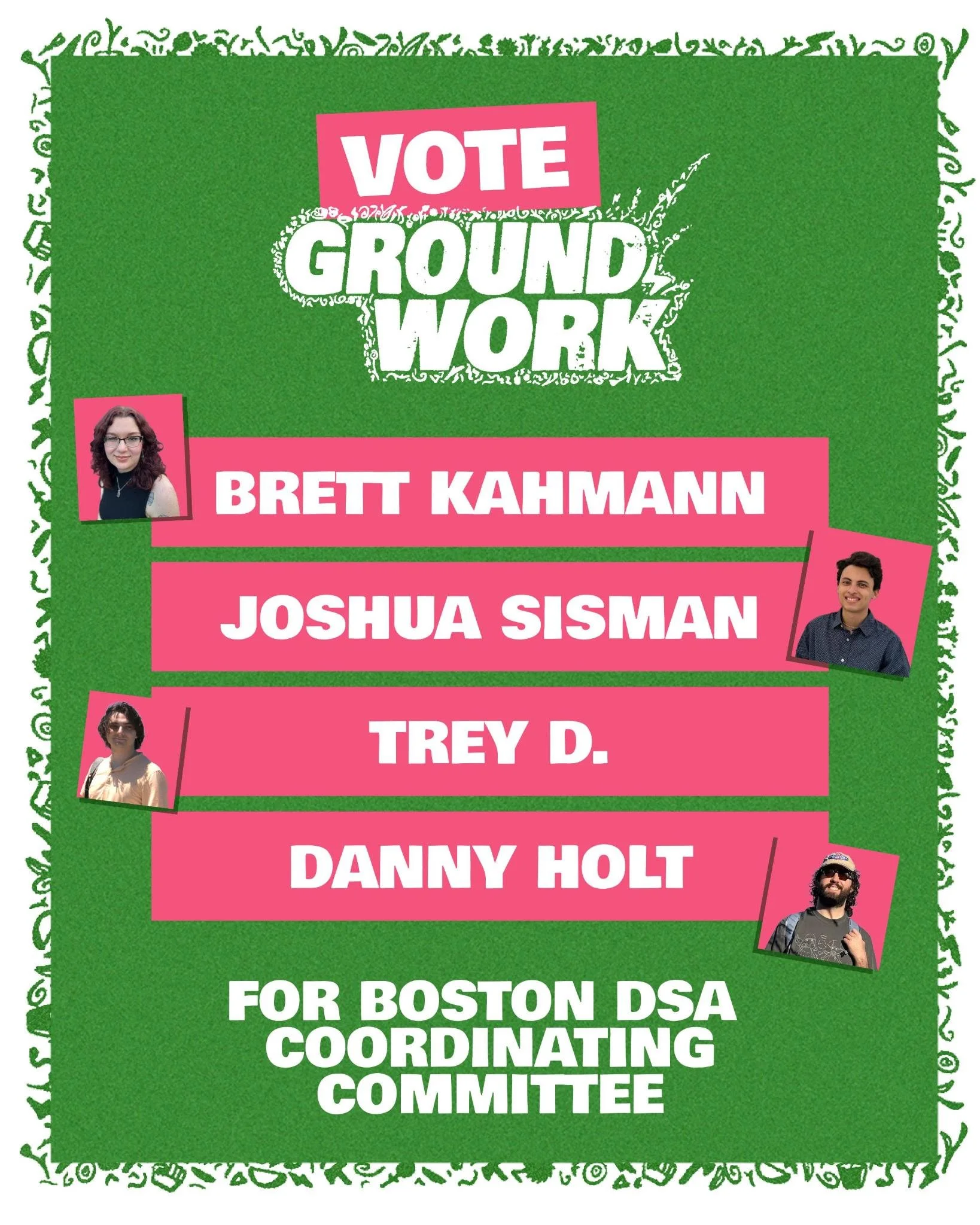
Brett K (she/they), candidate for Clerk, is a rank-and-file union member and co-chair of both the Cambridge Working Group and our Socialists in Office Committee, with deep experience building the coordination and accountability structures that allow members to understand and participate in the organization.
Danny H (they/them), candidate for At-Large, is a labor organizer and EWG Field Coordinator who has learned from years of campaign work that building organizations that keep producing leaders matters more than any single race.
Josh S (he/him), candidate for Communications Coordinator, is a political communications professional who built Evan MacKay's campaign brand and knows that a socialist organization without the capacity to carry its message beyond its existing base has already decided to stay small.
Trey D (he/him), candidate for Treasurer, is a software engineer and DSA National Electoral Committee member whose skills is exactly what a chapter at this scale needs managing its books, so that the chapter's financial and data infrastructure can support the organizing rather than lag behind it.
