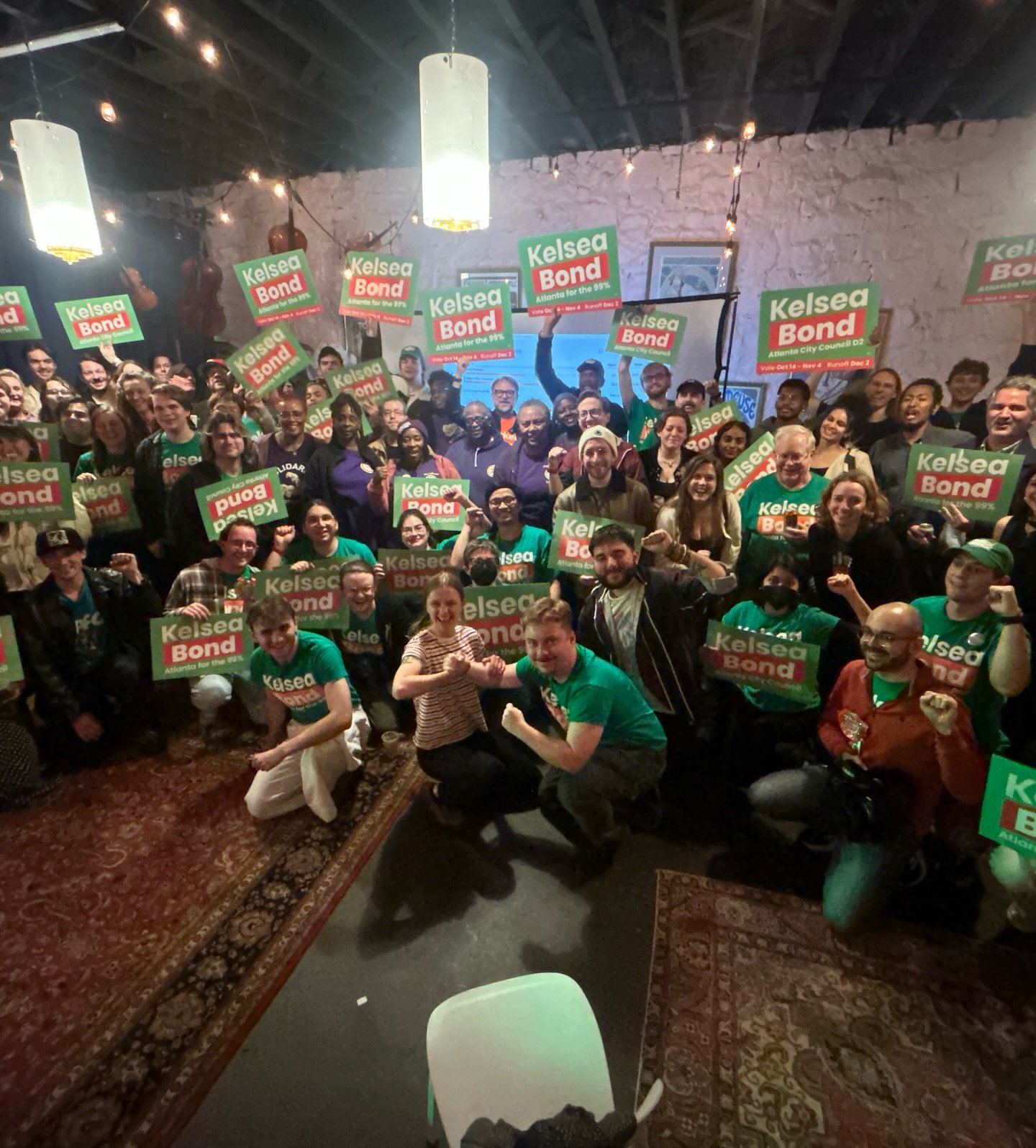
Atlanta DSA's Southern Breakthrough: Inside the Kelsea Bond Campaign

By Tom L
November 29th, 2025
"Once is never," begins the old saying, "but twice is always." In other words, something happening only one time can be dismissed as a fluke or a lucky break. If it happens again, however, it's the beginning of a pattern that could be here to stay long term.
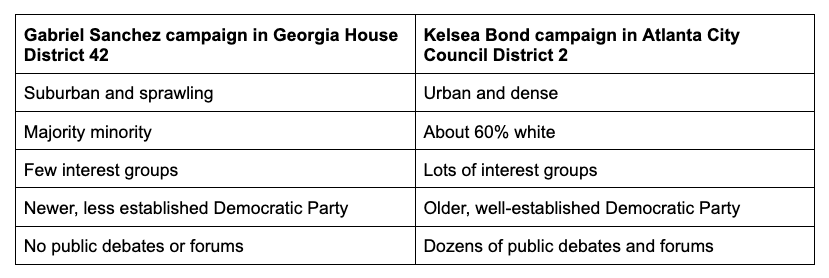
When Atlanta DSA’s candidate Gabriel Sanchez won an upset last year against an incumbent state representative in the Democratic primary, it was easy for commentators to write it off for dozens of reasons, not all of which, admittedly, are too off the mark. DSA did luck out a bit, certainly, by identifying a complacent incumbent who once retained her seat with just 59% of the vote against an opponent who had spent only $500. We heard from liberals and the establishment consultant class that, given that demographics are allegedly destiny, a young charismatic Latino candidate was bound to do well in a majority-minority district and the only surprising thing was that it hadn't happened sooner. But that's only the suburbs, they said. Of course DSA might do well in a place where the Democrats had been making inroads only in the last decade or two and where the party apparatus doesn't have a well-entrenched presence. “Once is never,” they endeavored to remind us. Just try that in the big city and see how far you get!
Well, on Tuesday the 4th of this month, Atlanta DSA did just that and won. And it wasn't a little win, either; with all precincts reporting, Kelsea Bond, the Democratic Socialist candidate in the District 2 City Council race, won 64% of the vote in a five-person race. Any plans by the city's ruling class to coalesce around another candidate in a runoff evaporated into nothing. They're learning quickly that twice is indeed always and, just like their equivalents in New York City, they're witnessing the beginnings a socialist electoral machine that could change the shape of politics in this country forever.
The fact that the Gabriel and Kelsea campaigns have been so different from each other emphasizes the strategic breadths and depths of Atlanta DSA's approach. If DSA was only winning in the suburbs or only in the heart of a big city or only among white people or only specific minorities, then the city's ruling elites could let out a sigh of relief, thinking "these socialists will hit the wall sooner or later, then they'll coming crawling back on their hands and knees, ready to play along." Between the Kelsea and Gabriel campaigns, though, it's hard to see where this will all come to a screeching halt. The only electoral bulwark the ruling class can depend on to thwart this encroaching socialism is elderly voters aged 65+, whose frequency and reliability in voting is matched only by the brutality of time's relentless march forward. Nothing screams desperation quite as loudly as hoping that all of today's 75-year-olds live another ten years so they can keep voting for you.
Whenever the ruling class feels the heat building up, they always fall back on the same playbook and shout to the heavens their favorite canard: "Order prevails in Berlin!" Some have rightly pointed out that, although Kelsea did extremely well in their race, none of the other upstart progressive challengers in the metro area won that Tuesday night. While Atlanta DSA was primarily focused on the Kelsea Bond campaign, it did issue a voter guide offering critical support for many of these progressive challengers throughout the Metro Atlanta area. Although these results might have somewhat dampened the enthusiasm of an otherwise exuberant night, Atlanta's capitalist class would be well-advised to look at the margins. City Council president candidate Marci Overstreet defeated her progressive opponent Rohit Malhotra by a measly 3%, mostly due to elderly voters in the southwest of the city. Sam Foster, a progressive insurgent candidate for the mayor of the suburb of Marietta, lost by a mere shave of a fraction of a percentage point. Hopefully the 78-year-old mayor-elect feels fresh and energetic enough to run again in four years' time so he can fend off another challenge from us whippersnappers!
So that we may learn from Atlanta DSA's tried and proven approach, let's recount briefly the history of the Kelsea Bond campaign and see if we can draw out any political lessons.
Beginnings
The campaign started out much like the Gabriel campaign of a year prior: identifying an election Atlanta DSA was predisposed to do well in. For Gabriel's campaign, they identified a weak incumbent who would underestimate DSA's ground game. For the Kelsea campaign, the chapter sought out a potential electoral stronghold; a place where many members live and has an electorate that could swing decisively our way.
This naturally led the chapter to set its sights on District 2. Many chapter members live in the district, including Kelsea, who has been a cadre of Atlanta DSA for many years and gained prominence for their work in the Stop Cop City campaign and the local labor movement. In fact, the district was one of the most receptive to the Stop Cop City referendum petition campaign, with a high density of signatures. The incumbent councilmember, Amir Farokhi, had been less present in recent years, rumored to be considering vacating the seat soon, especially if faced with a strong challenger.
And that's exactly what he did. Within weeks of Kelsea announcing their campaign, Farokhi announced that he would step down to take up a position as headmaster of a prestigious local private school. This cleared the field for Kelsea, but it did so for everyone else, as well.
The Opposition and The Terrain
A slew of candidates appeared, the most prominent being Courtney Smith, the president of the Midtown Neighbors Association. Due to her longstanding ties to the real estate development lobby, the local ruling class eventually chose to coalesce around her candidacy, with real-estate developers and Republican mega donors investing tens of thousands of dollars into her campaign.
Kelsea distinguished themselves quite clearly from the rest of the pack; being the only candidate who could truthfully claim to not take any corporate donations resonated well with voters. It didn't hurt that they were the only candidate to clearly oppose Cop City, and to speak out against the Mayor’s administrations’ cruelty against Atlanta’s houseless community and waffling on public transit projects.
District 2 being Atlanta’s most dense and quickly growing district, it was inevitable that urbanism and YIMBY/NIMBY politics would play a big role in this election. The Kelsea campaign recognized that transit enthusiasts and urbanists would have to form an important part of the coalition to win this campaign. One candidate, Jacob Chambers, the former leader of the Young Republicans of Georgia Tech who stepped down after Donald Trump was impeached in 2019, tried to reinvent himself as the urbanist candidate in the race, proposing Strong Towns adjacent messaging around zoning reform and streamlining building permits. By contrast, Kelsea was able to champion transit, urban density, and environmental issues with a distinctly socialist perspective that spoke to economic insecurity and equity. The Kelsea campaign not only won the YIMBYs and the urbanists over with clear and principled stances, but actually won over many development-skeptical residents, who appreciated Kelsea's refusal to take real estate lobby money and were put off by Smith's plea to "think from the developer's perspective."
Over the past several years, a controversy has arisen in Atlanta over whether to build the promised light rail around the Beltline, a rails-to-trails conversion that has been in the works for over twenty years. The arguments against Beltline Rail are of the typical Ugly American car-brain fare: rail would reduce property values, construction would be noisy, and transit would attract "undesirable elements." Much of the push against Beltline Rail has been astroturfed by dark money groups with ties to the automotive and fossil fuel lobbies, but that doesn't necessarily mean their muddying of the waters has had no effect. How much did the residents of District 2 actually support or oppose Beltline Rail?
After commissioning some polling of the district, Kelsea's campaign discovered that District 2 overwhelmingly supported building rail, almost by two-thirds. Conversely, only a measly 21% opposed it. Opposition to Beltline Rail was and had always been a paper tiger. Armed with this knowledge, the Kelsea campaign tripled down on their support. It's probably not a coincidence that Kelsea won a percentage of votes roughly equal to that of the pro-rail respondents in the poll: 64%.
Time and time again, Kelsea's campaign made clear statements on policy and took principled stands. Time and time again, their opponents dithered and made vague gestures. Because Kelsea had monopolized the left wing of the electorate and endorsement field, their opponent reflexively took more right wing positions, which wouldn't serve them well with voters like District 2's.
Managing a Campaign
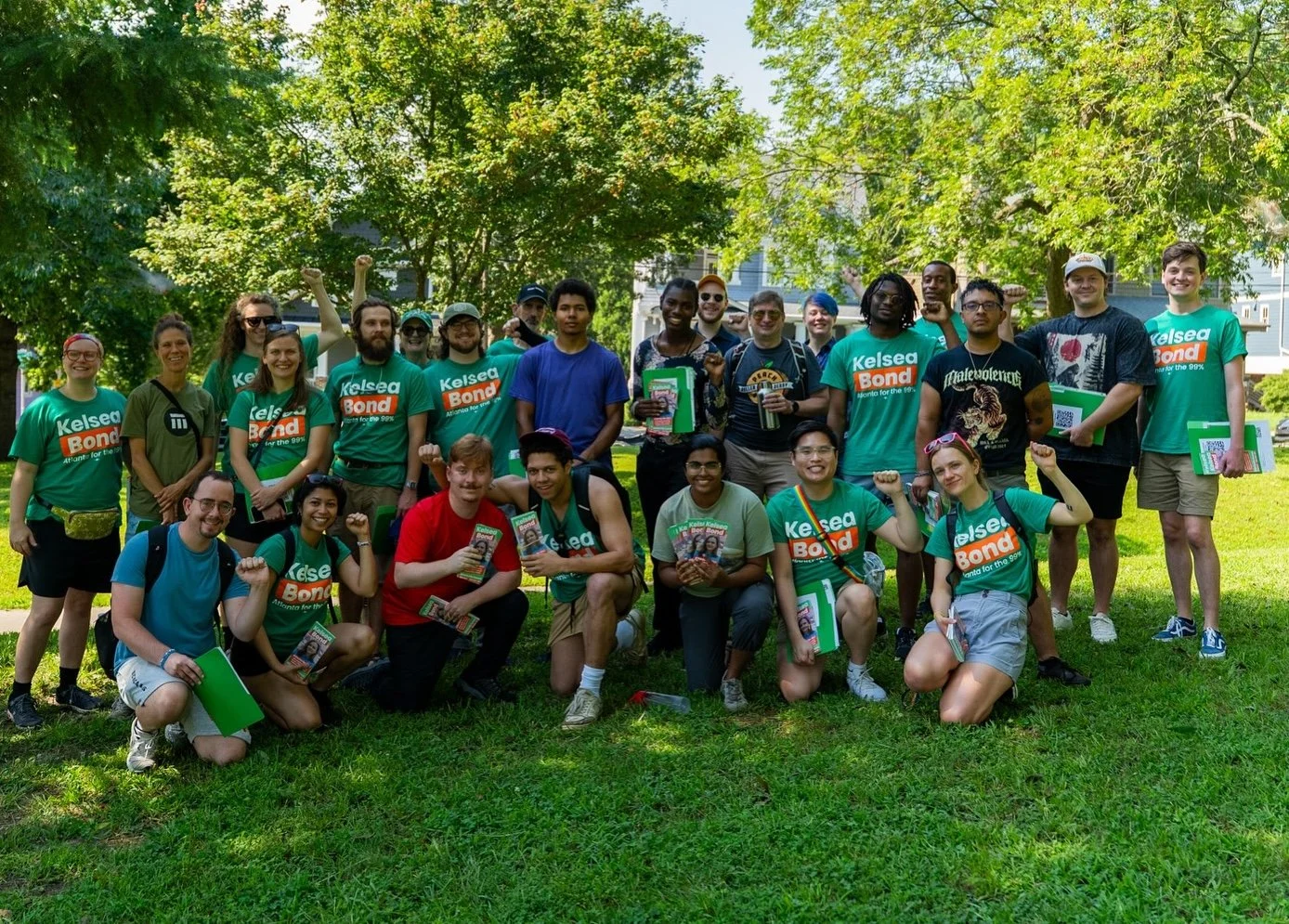
Much has been written about how organizing canvassers and volunteers made all the difference in the Zohran campaign. The same held true with Kelsea's. There were certain advantages, of course; the campaign received more donations than initially anticipated, which gave them more room to maneuver and hire, including thirty-five paid field staff, an incredible amount for a city council campaign. District 2's density and compactness made canvassing much easier, as well.
That's not the whole story, though. Every other candidate should've been able to benefit from the district's geography, and Courtney Smith had lots of donations coming in from the real estate lobby. The fact is that no amount of money can make up for high levels of enthusiasm properly deployed by experienced organizers. Starting off with just weekend canvassing shifts, by summertime the Kelsea campaign soon expanded to weekdays. In the final weeks before the election, the campaign was hosting nine shifts a week.
Along the way, leadership identified the most effective and consistent canvassers and developed them into shift leads. Two leads were assigned to each shift and would be responsible for distributing materials, cutting turf, and showing new canvassers the ropes. Over sixty shift leads worked on the campaign. Under- and unemployed volunteers and leads, including many students, were identified and brought aboard as paid staff. Directed by paid staff organizers tasked with managing the schedule, this process snowballed into an unstoppable political force that, in hindsight, we now know the other candidates couldn't stand a chance against.
There's always room for improvement, of course, and the Kelsea campaign as well as Atlanta DSA have identified some pain points. In terms of canvassing, the biggest barrier was entering locked and heavily-guarded apartment complexes in Midtown Atlanta. Closer ties with residents through tenant unions and associations would have made overcoming this barrier much easier.
The Results
The press has mostly focused on Kelsea's crushing margin, but delving into the data further emphasizes how total the campaign's victory really was.
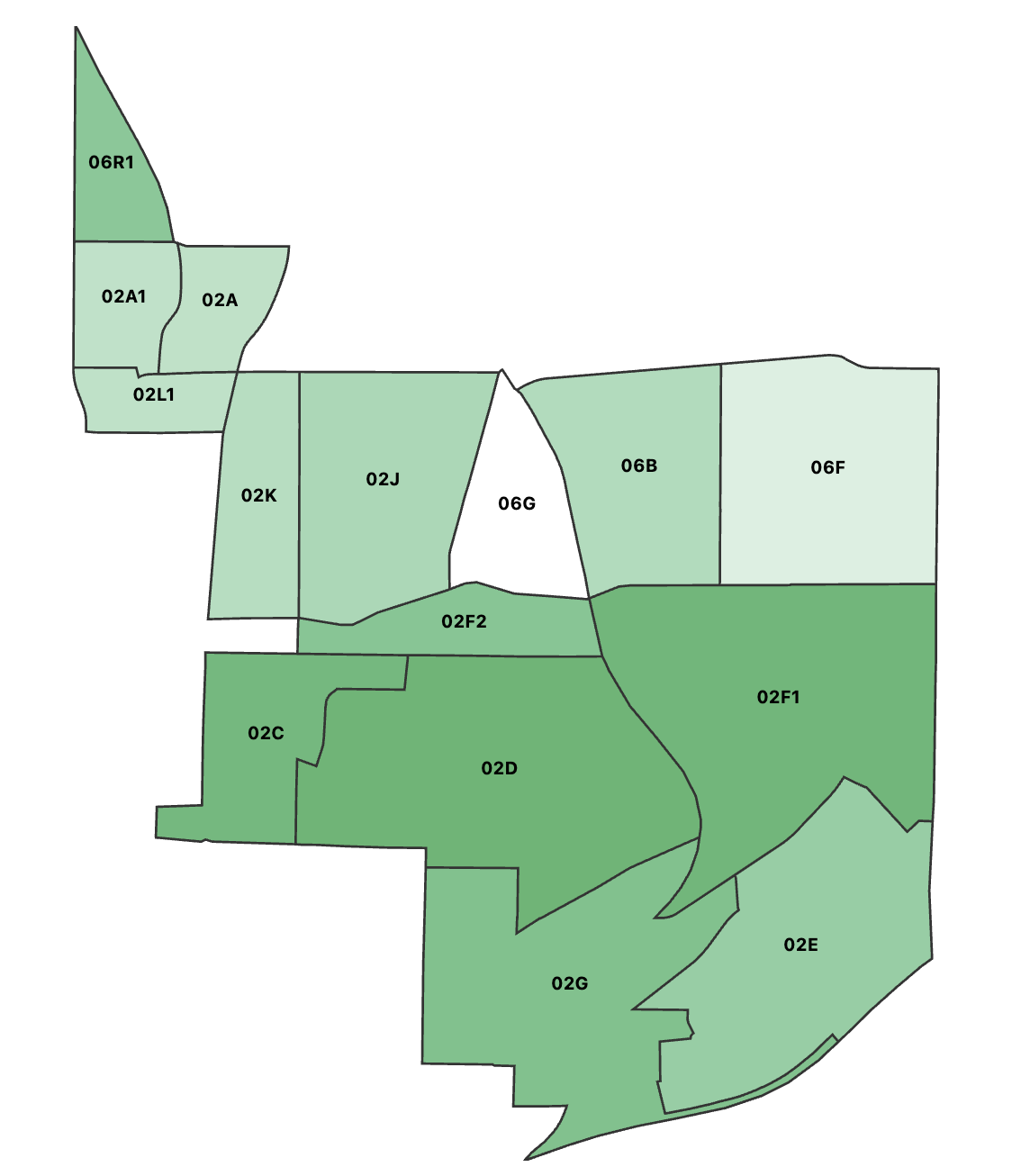
Map: Kelsea’s percentage by precinct. Kelsea’s lowest performance was in Precinct 06G, where they won “only” 48%.
Each of Kelsea's opponents did better in and around their home precincts, but despite that, Kelsea ended up winning all precincts, with a majority in all but one precinct (06G), where Kelsea landed at 48%. In terms of geography, Kelsea performed best below Ponce De Leon Avenue, away from wealthy neighborhoods like Midtown and Virginia Highland and closer to younger, more diverse, and heavily rented neighborhoods like the Old Fourth Ward and Poncey Highland. While the progressive left in Atlanta is still struggling to make deep inroads into the city's ever-important Black community (as evidenced by southwest Atlanta handing Marci Overstreet a narrow victory over WFP-backed Council President candidate Rohit Malhotra), Kelsea's campaign actually outperformed other progressives among Black voters, particularly with legacy residents in Old Fourth Ward struggling against gentrification and displacement.
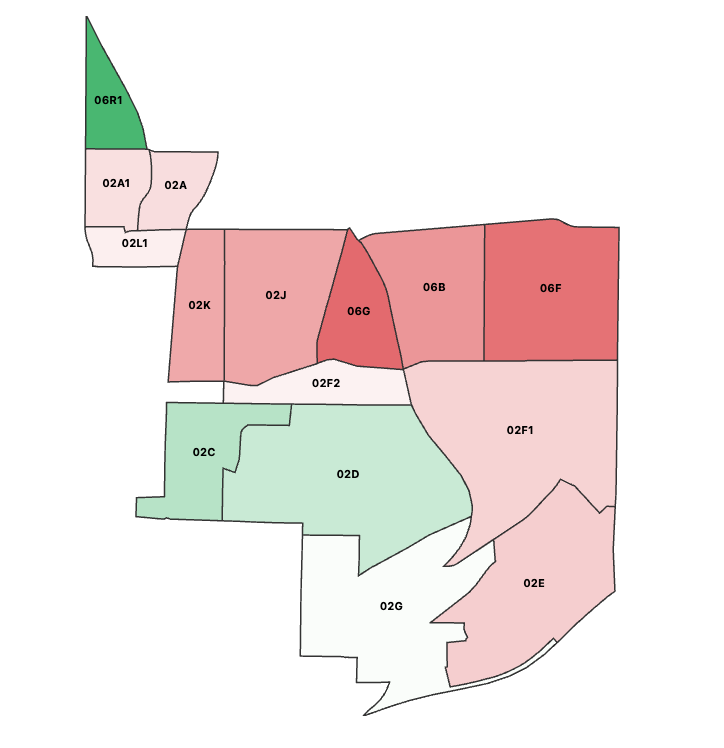
Map: Kelsea Bond’s outperformance (green) relative to Rohit Malhotra’s (red). Kelsea significantly overperformed Rohit in heavily Black precincts, such as 02D and 02C, and underperformed in heavily white precincts, such as 06G.
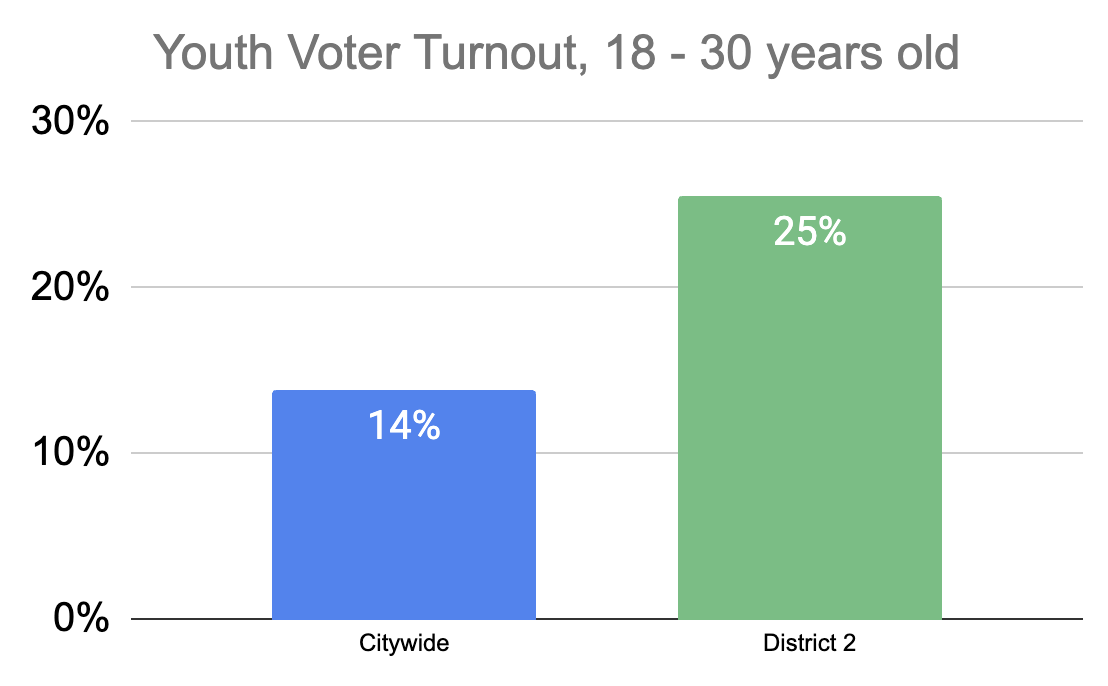
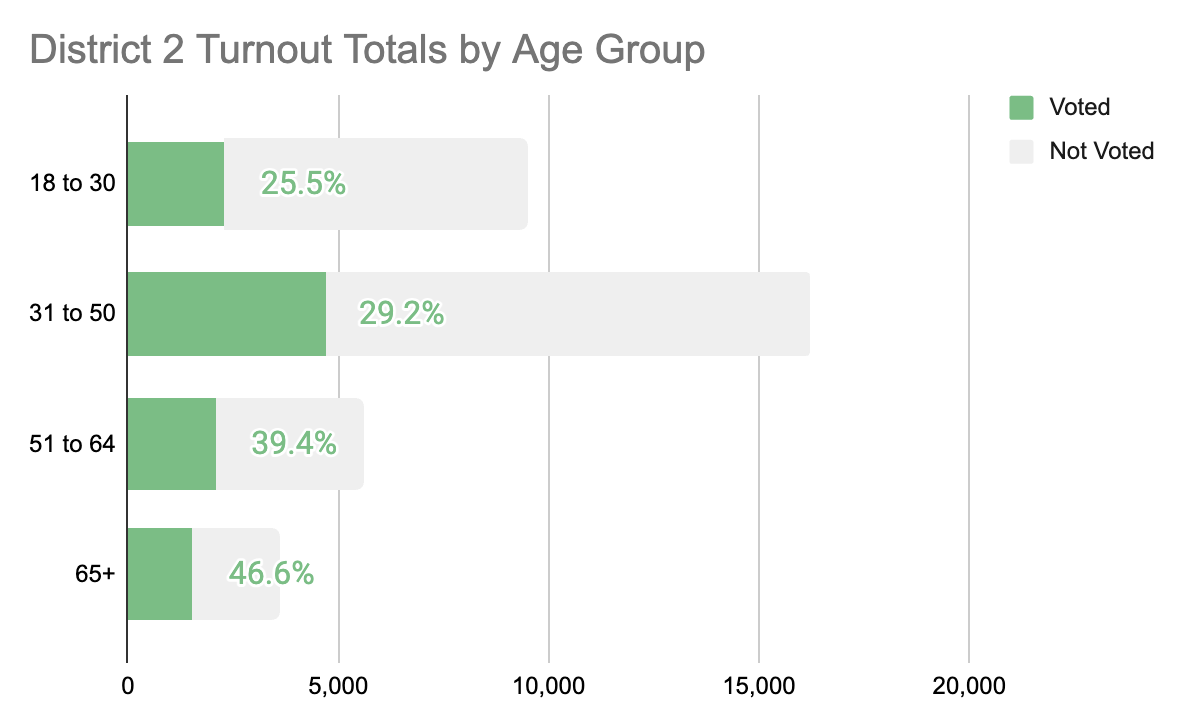
Kelsea especially shined among the youth. The campaign expanded the electorate by driving up youth turnout among under-30 voters significantly higher than the citywide average (almost double, in fact). As a result, the 18 to 30 age group had more voters than both age groups for 51 to 64 voters and 65+ voters.
The Future
The future looks bright for Atlanta DSA, and within the organization, there's already discussion on how best to proceed in the 2026 primary cycle. With a number of candidates applying for the chapter endorsement, Atlanta DSA organizers are hoping to focus on a few races and execute them well. More importantly, though, Atlanta DSA can use this interregnum to build a base off its hard won mandate, through issue campaigns to win Kelsea's platform on City Council, basebuilding in the district to organize campaign supporters into new labor and tenant unions, and continuing to grow the Atlanta DSA chapter, which is fast approaching 1,500 members. As Kelsea themself puts it: "We have power inside the city council because we have it outside the city council!" With once and twice firmly behind them, Atlanta DSA is very much looking forward to thrice, four times, and beyond.